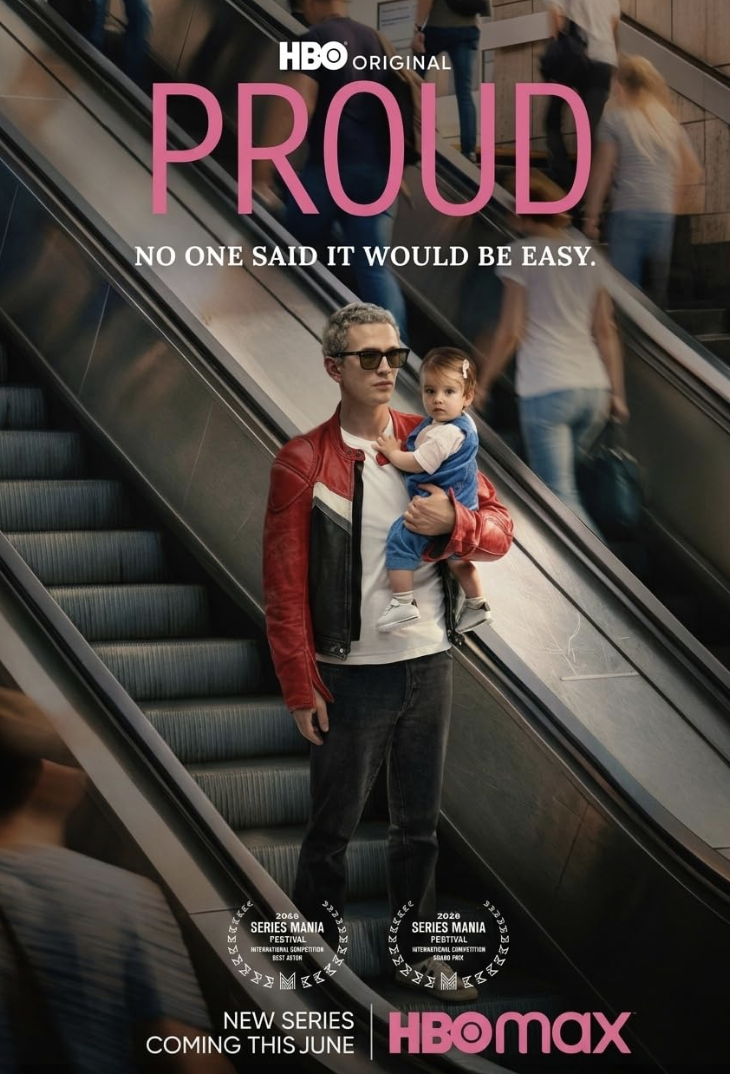
Originally premiering on HBO Max, this is honestly one of the most distinctive queer stories out there, centered on those particular points in life when you have no choice but to grow up quickly, when discipline, tenderness, and genuine sacrifice become non negotiable. It’s a deeply moving portrayal of accidental gay parenthood, following a hard partying twenty something gay model whose entire world shifts when he’s forced to raise his niece. There are eight episodes altogether, and I’d genuinely recommend taking your time with this one and letting it sink in rather than speeding through it.
The series opens with a gay orgy and introduces Filip, a model caught up in drugs, parties, sex, and pretty much refusing to take anything seriously, including his work. He has the looks and the sharp jawline, and he assumes that means he can get away with anything—until his sister gives him an ultimatum and tells him to move out, because he’s essentially been living off her while she raises her one year old by herself. Things then take a devastating turn when she dies in an accident, leaving Filip suddenly responsible for his niece, Tosia. Since he grew up in the foster system himself, he chooses to pursue legal guardianship, but it means facing a mountain of problems: lawyers, social workers, and the foster system, all while knowing Poland is not going to easily give a child to a single gay man. This is where his chosen family becomes especially important. There’s Kiki, his sister’s friend and a single mom who is separated but may be moving toward reconciliation; her sixteen year old daughter, who occasionally babysits Tosia; his gay best friend Olek, who is completely in love with him and winds up showing Filip just how much he has always been there for him, something Filip never fully clocked; and the chaotic neighbor, who, despite all their friction, becomes a major part of Filip’s fight for legal guardianship. Amid all of this, Filip may also be falling for a man named Pawel, experiencing something he truly never thought he could feel. But now that Tosia is part of the picture, Pawel starts to question where any of it could be going. Then there’s another curveball: Tosia’s grandmother decides she wants back in the baby’s life and pushes for adoption, even though the father has made it painfully clear that he wants nothing to do with the child.
At its heart, Proud is about pain, shame, and a profound need to truly connect with someone. It explores grief through people’s actions rather than their words, following a man who can barely look after himself when he suddenly has to protect someone entirely dependent on him. The show balances dark comedy, queer identity, family trauma, and the pressure of Polish society with real precision. Filip is clearly the center of it all, and his scenes with Tosia are so authentic and beautifully handled that you completely believe their bond. Whoever cast Filip absolutely nailed it. He’s hot, charming, cocky, and overflowing with swagger, but all of that starts falling away the moment real responsibility shows up. It isn’t an overnight transformation, either; it unfolds slowly and messily, exactly as you’d expect for a guy learning to raise a one year old for real. Tosia doesn’t magically change him. What’s more interesting is that he begins wanting to change before he even understands how to do it. The actor is amazing at keeping Filip’s unspoken pain beneath the surface, always seeming like that cocky exterior could crack at any second. Another major strength is the found family around Filip. Olek is so loyal and so in love with him that he would sacrifice himself before letting anything happen to Filip or Tosia. As a young mother herself, Kiki understands more about caregiving, but she’s flawed too—exhausted and worn down by her own life. The alcoholic neighbor could easily have been a throwaway joke character, yet the show gives her real pain, making her presence genuinely matter. All of these people feel funny, needy, bruised, and generous. Their love is practical. They keep turning up, tolerate Filip at his worst, and believe in a better version of him that even he cannot quite see in himself yet. The romance between Pawel and Filip could have used more development, though. I never fully bought how or why these two fell for each other so fast, even if their on-screen chemistry still worked well.
Dark humor continues to run through the show’s grief. The ending remains open, although you can more or less see where the custody case is going. Proud is an honestly exceptional drama about what it means to be gay in Poland today, and it’s a great choice for anyone wanting something emotionally heavy that truly hits. It also serves as a sobering reminder of how fragile LGBTQ+ rights still are in deeply religious societies. The show never reaches for easy victories or preachy speeches. Instead, it stays with the pain, the shame, and that desperate need for real human connection. (8.5/10)


Comments