
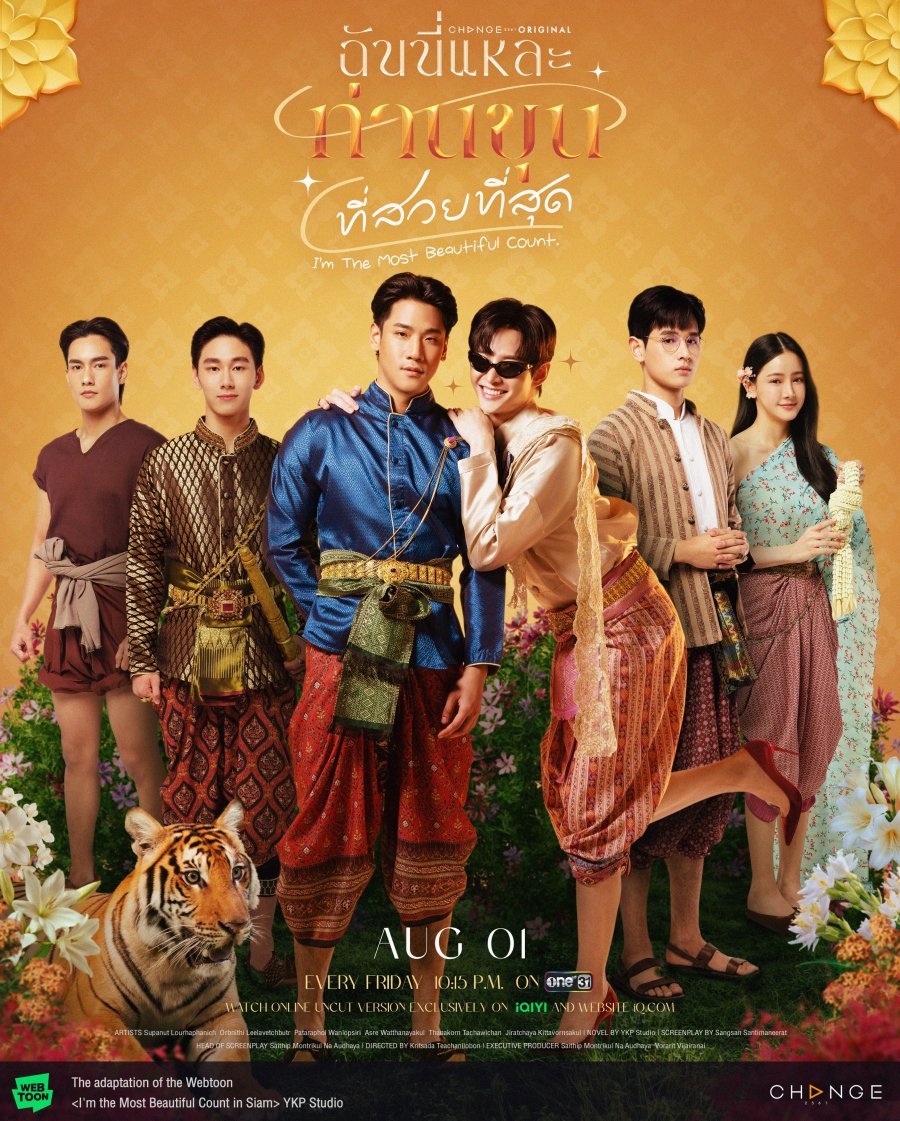
I’m The Most Beautiful Count is gloriously excessive in the best possible way. It takes time travel, court intrigue, queer resistance, comedy, and historical melodrama, throws them into one loud package, and somehow makes the chaos feel energizing instead of desperate. For viewers tired of interchangeable BL formulas, this series arrives like a jolt.
The story begins with Prince, an openly flamboyant modern celebrity, waking up inside the body of a nobleman in the Thonburi era. Thrust into a political world where power, repression, and public performance are inseparable, he has to survive palace schemes while also reshaping the space around him. The historical setting becomes more than a costume backdrop because the show uses it to explore gender expression, social control, and rebellion without losing its comic edge.
The real engine of the series is its lead. The actor playing Prince and Woradet understands that camp only works when performed with total conviction, and he gives the show its pulse. His timing, movement, and swagger turn even exaggerated scenes into pure entertainment, while the writing smartly allows humor and vulnerability to coexist. That balance keeps the character from becoming a gimmick.
The supporting dynamics are strong too, particularly the tension between romantic longing, political loyalty, and rivalry. The love triangle material is actually fun rather than irritating, and the half-brother conflict at the center of the power struggle gives the show more dramatic texture than expected. Underneath the theatricality, there is a sincere interest in freedom, dignity, and chosen identity.
The show is not perfectly controlled. Some plot turns are rushed, and parts of the political narrative can feel busier than they need to be. It occasionally asks the audience to follow emotional logic more than strict narrative logic, especially near the ending. But the pace is lively enough and the performances strong enough that most of those weaknesses feel forgivable rather than fatal.
What makes the series memorable is how confidently it commits to its own tone. It is funny, romantic, visually bright, and openly queer without apologizing for any of those qualities. Instead of sanding down its personality to feel “prestige,” it leans harder into spectacle and charm, which turns out to be exactly the right choice.
In the end, I’m The Most Beautiful Count works as a campy yet emotionally sincere historical BL with a genuine point of view. It may wobble here and there, but it is far more alive than most safer shows, and that makes it easy to celebrate.
Rating: 8/10
/>


